A Sub-Basin transforms precipitation into runoff by the processes of runoff generation and runoff concentration.
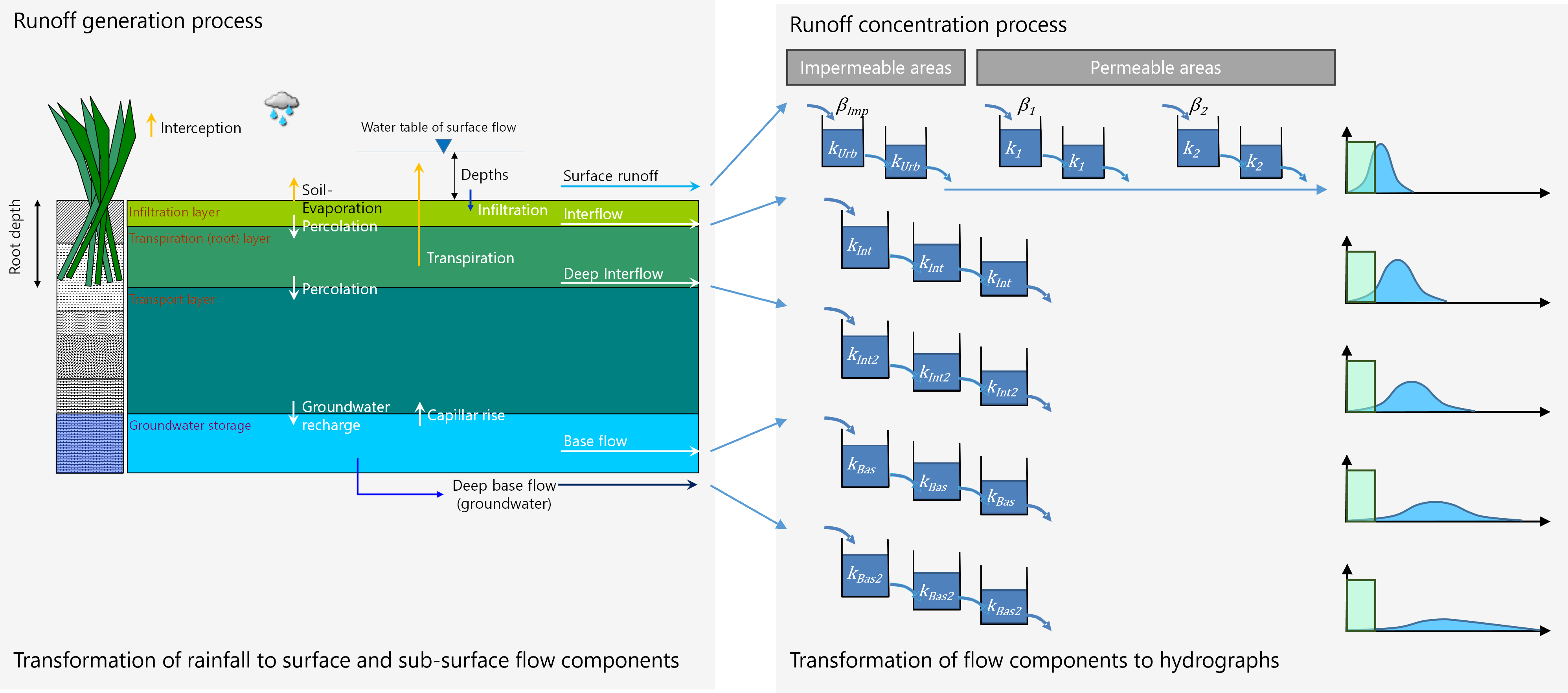
Runoff generation describes the transformation of rainfall to surface and sub-surface flow components, thus it determines the amount of water that becomes runoff.
Runoff concentration represents the routing from the source areas to the outlet of the Sub-Basin, thus it transforms the flow components into a hydrograph.
Talsim models the runoff concentration by a set of parallel cascades of linear reservoirs. The sub-surface runoff components run through one cascade with individual retention coefficients for the reservoirs of each cascade. The surface runoff component is further divided into three linear reservoir cascades: The Urban cascade for the proportion of Surface runoff generated on the impermeable areas of the Sub-Basin, as well as a Fast and a Slow cascade for the rest of the Surface runoff.
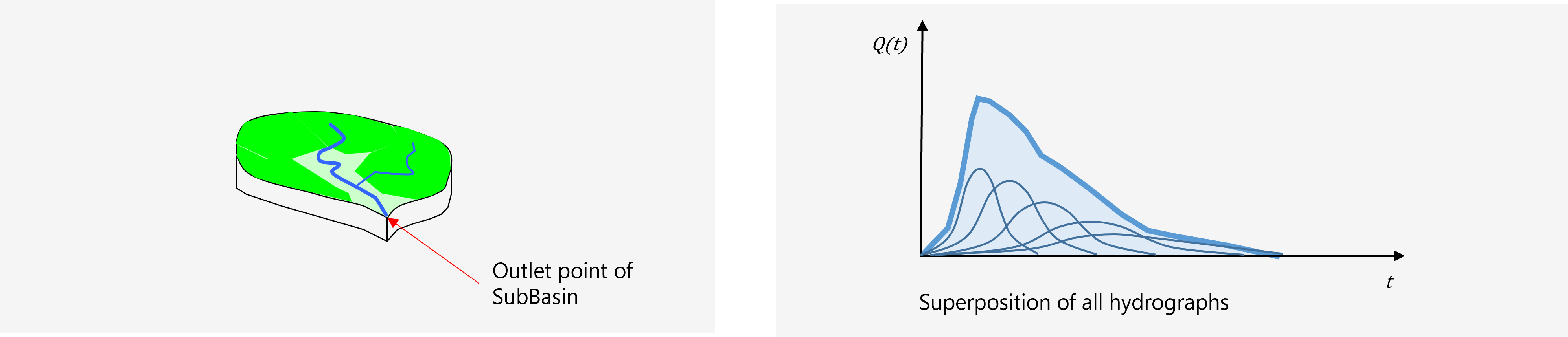
The total outflow from the Sub-Basin at its outlet point is the sum of the outflow of all the storage cascades at each time step, thus the superposition of all the hydrographs.
|
Runoff concentration does not affect the mass balance but only the shape of the hydrograph. |

|
The default number of storages per cascade is two for the Surface runoff cascades and three for all the other cascades. This may be changed during calibration to a maximum of five storages. |
|
The event based methods for the computation of the Runoff generation only consider the generation of Surface runoff from precipitation, so only the Surface Runoff cascade is used. Additionally, for these methods, a constant baseflow (optional with annual pattern) can be specified. This baseflow is independent of the precipitation. |

