 Storage elements are used to store an inflow and, depending on the current storage content and operating rules, to release water for different uses to up to three different system elements. With the possibility to regulate and control releases, it is an extremely flexible system element with a variety of options. Originally, the storage element was developed to represent reservoirs behind dams, but it can also be used to model other storage facilities such as flood control reservoirs or similar. Additionally, it is possible to optionally simulate the addition of water to the storage facility by precipitation, as well as losses from the storage facility by evaporation and infiltration.
The storage system element can also be used to simulate hydro power plants.
Storage Elevation Curve
The Storage Elevation Curve defines the relationship between storage content (volume), water level and surface area. It forms the basis for all calculation options that depend on not only the storage content but also the water level and/or the surface area e.g., precipitation/losses, flow over a weir, pressurized flow through pipes.
Releases
The term release is used to describe any discharge of water according to operating rules from the storage element to the downstream area through regulated or unregulated outlets. This includes controlled releases through operating and bottom outlets as well as releases via a spillway.
Releases are often related to operating rules, therefore, it is possible or sometimes also necessary to define several releases for each outlet.
Different Calculation Options exist for defining the release of a Storage element:

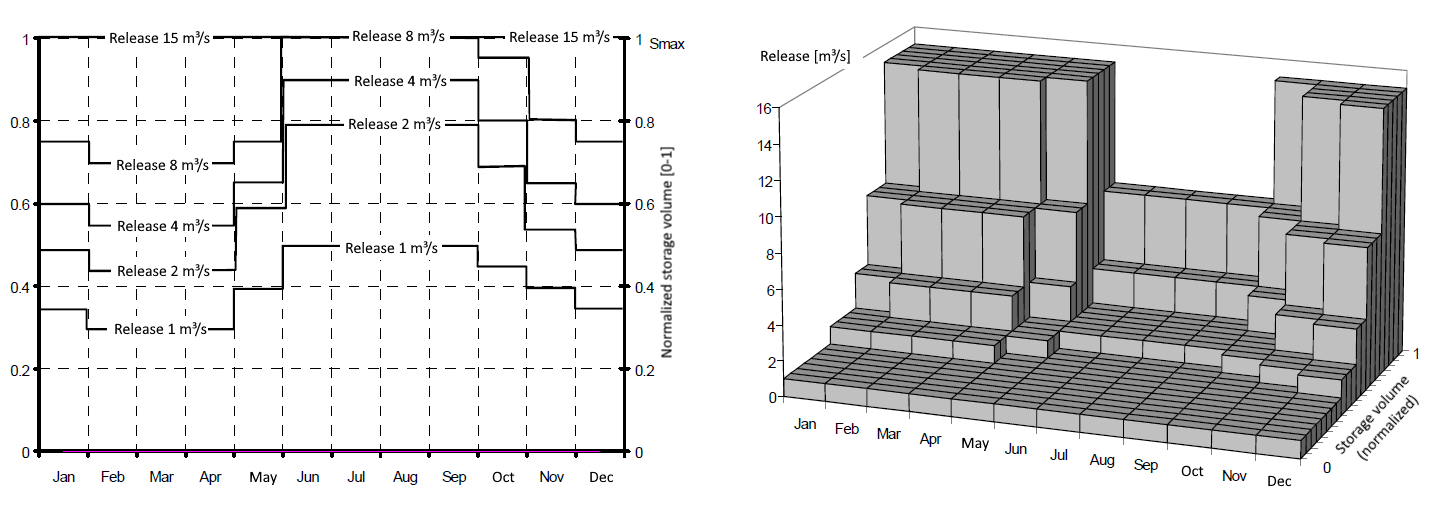
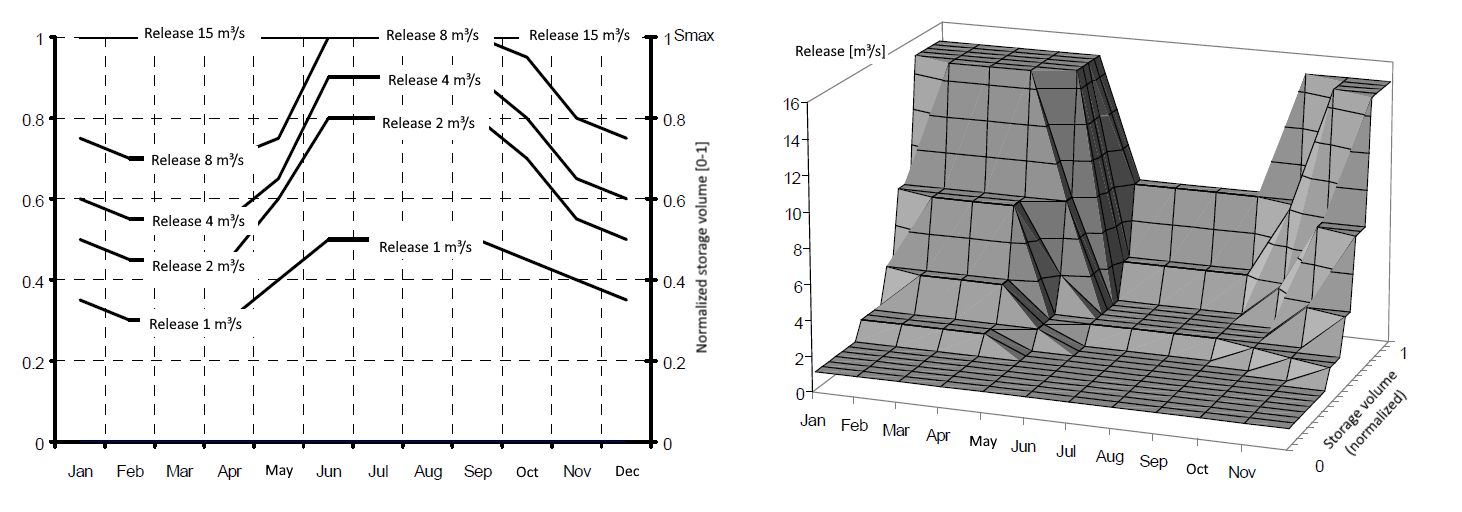
Independent of the selected calculation option, releases can always be scaled with a system state/control cluster, which makes it possible to model complex operating rules, which are not only dependent on states within the storage, but also on other states within the river basin.
Constraints
The maximum physically possible output of individual outlets can be entered as functions of storage volume, causing releases to be limited to these values. It is also possible to specify a minimum permissible release value, below which the release will be set to 0.
Internal dependencies
Internal dependencies are used to define the priorities in case of multiple competing releases from one storage element. One or more releases can be reduced if another release exceeds a certain amount or if the storage volume falls below a certain value.
The limits for releases and storage volumes for internal dependencies are entered as constant values, which can however be scaled with daily, weekly and/or annual patterns.
If several releases are to be reduced simultaneously, the order in which they should be reduced must also be specified.
Example: If release B > 0 and the storage volume S < X, then reduce release A by the amount of release B, but at most to a minimum value of zero.
This means that there is a linear relationship between A and B until B is equal to the value of A. If the value of B rises any further, A still remains zero.
Precipitation/Losses
An addition of water caused by precipitation onto the storage's surface or losses caused by evaporation or infiltration can be considered via two options:
•Constant pattern (daily, weekly and/or annual pattern)
•Time series
These can be additionally scaled by a factor. Precipitation, evaporation and infiltration values must be provided as a linear unit such as e.g. mm. During the simulation, the provided values are converted to water volumes by multiplying with the current storage surface area.
