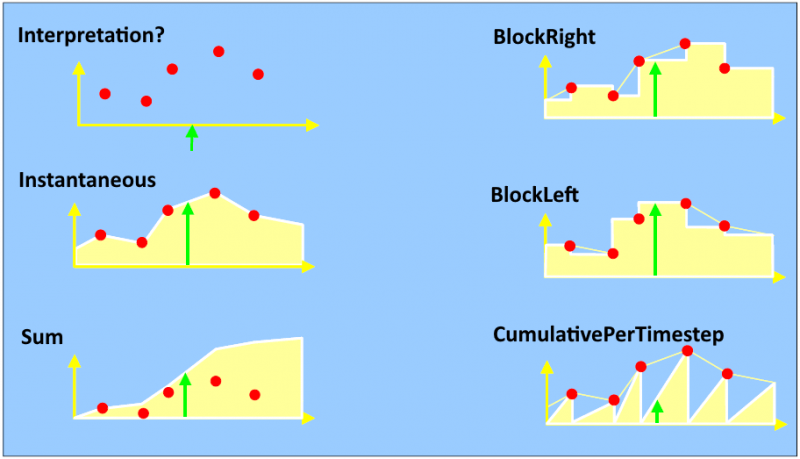
Interpretation of time series
Time series represent chronological sequences of values, where each data point is associated with a specific timestamp. Both measured and simulated time series can be used as model inputs.
To ensure consistent model behavior, time series must be gap-free for the full simulation period. Any missing values should be filled in beforehand (e.g., using regression methods or assumptions based on similar datasets). Ideally, time series are equidistant and match the time step resolution of the simulation, though this is not strictly required.
In addition to the values themselves, correct interpretation of the time series is essential — for example, understanding whether values represent averages, totals, or instantaneous measurements. It is also crucial that units are appropriate (e.g., m³/s for discharge, mg/l for concentration). Some system elements allow time series values to be scaled by an additional factor.
Time series are assigned to system elements via their data sheets, but are created and managed centrally using the Time Series Manager. They are stored on the server and can be reused across multiple projects and variants within the same organization.
